
5 Open Source Alternatives To Neo4j
The best Graph Database, and Database tools similar to Neo4j
Omnigraph stands out as a leading open-source alternative to Neo4j. For those seeking different features or workflows, we've curated a comprehensive list of Neo4j alternatives, each offering unique strengths.
Notable mentions in the Neo4j alternative space include: ArangoDB, JanusGraph, Dgraph, Memgraph.
The Neo4j ecosystem primarily consists of Graph Database solutions, with additional options in Database. Explore these alternatives to discover tools that align with your specific Neo4j-related requirements, whether you're looking for enhanced features, different user experiences, or specialized functionalities.
 Omnigraph
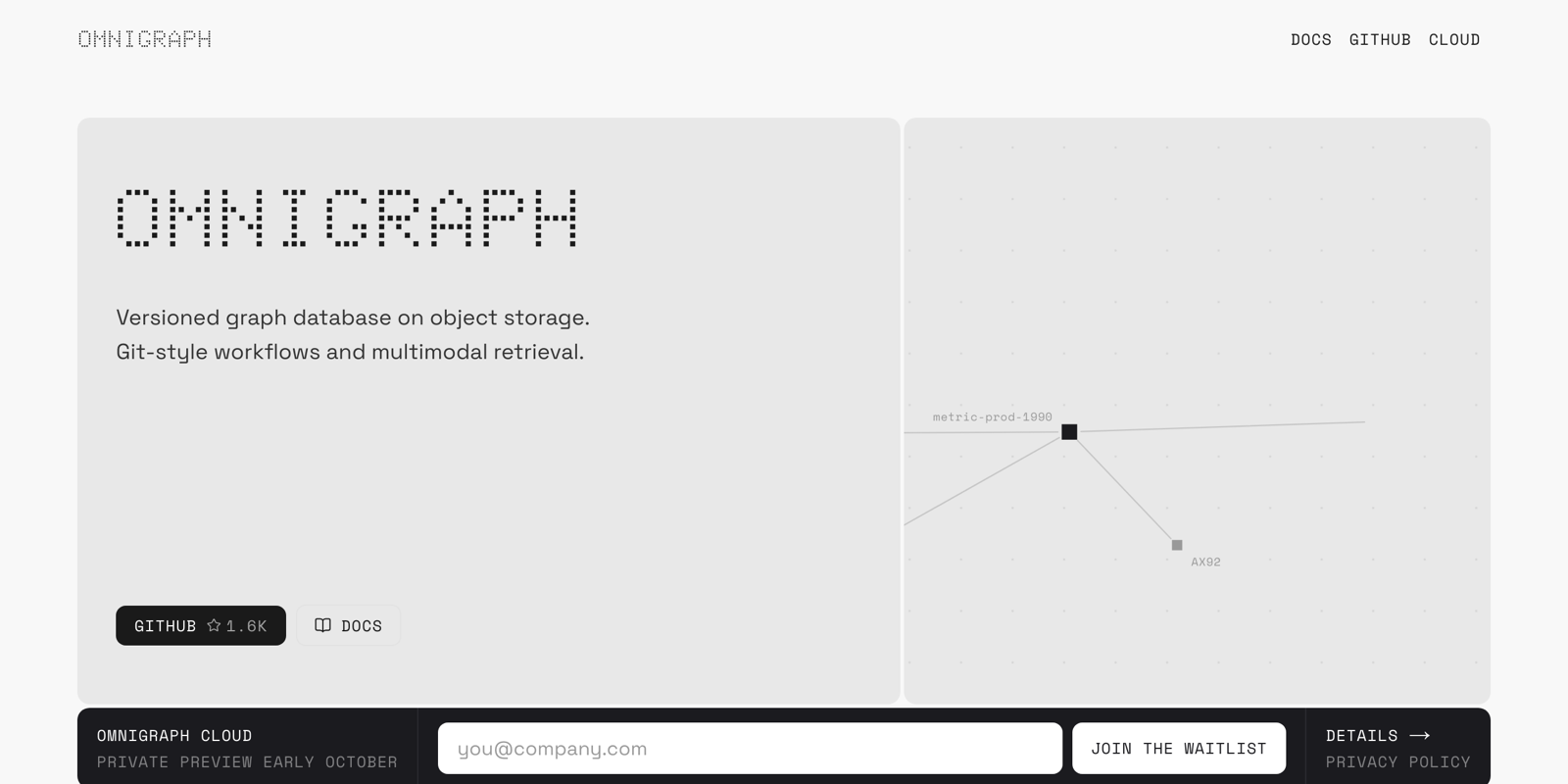
Omnigraph is an open source graph database built for workloads where many AI agents share, read and update the same body of knowledge. Instead of running on a dedicated server with its own disks, it stores every graph in the open Lance format on local disk or any S3-compatible object store, which keeps storage cheap and the data fully in your hands. Graphs are versioned like code: agents and people work on branches, review changes and merge them back. Written in Rust and released under the MIT license, it ships as a single CLI and server, with an MCP server for connecting agents directly.
- Typed ontology:
.pgschema files declare node and edge types, keys and constraints, and the engine enforces them on every write, so every agent works against the same model of the domain. - Multimodal retrieval: One
.gqquery combines graph traversal, vector nearest-neighbour search, BM25 full-text search and filters, merged with Reciprocal Rank Fusion, to assemble precise context in a single round trip. - Git-style branching: Create a branch per agent or task, diff and review changes, run three-way merges and time-travel across the full history of the graph.
- Object-storage native: Runs on local disk, RustFS, MinIO, AWS S3, Cloudflare R2 or Google Cloud Storage, with data kept in open, versioned Lance files.
- Declared as code: A
cluster.yamldescribes graphs, schemas, stored queries, embedding providers and policies, applied with a Terraform-styleplanandapplyworkflow. - Security as code: Cedar policies are enforced server-side on every mutation, with bearer authentication, server-resolved actors and audit tracking.
- Agent-ready tooling: Includes an MCP server, SDKs and an agent skill that teaches coding agents how to operate a cluster.
Omnigraph is a strong option for teams building agent memory, company knowledge graphs, context graphs or versioned research data, who want an alternative to Neo4j, TigerGraph or Amazon Neptune without running a separate database cluster. Its branching model, open storage format and combined graph and vector search make it especially well suited to AI applications where context has to be both reliable and reviewable.

ArangoDB is a native multi-model database designed to support a variety of data models including documents, graphs, and key-values. This flexibility allows developers to build high-performance applications using a single, unified platform. With a convenient SQL-like query language and JavaScript extensions, ArangoDB simplifies the development process and enhances productivity.
- Multi-Model Support: ArangoDB supports documents, graphs, and key-values, making it a versatile choice for diverse data requirements.
- Unified Query Language: The SQL-like query language (AQL) provides a familiar and powerful way to interact with your data, accommodating a range of access patterns like traversals, JOINs, search, and geospatial queries.
- High Performance: Optimized for performance, ArangoDB ensures rapid data processing and retrieval, making it suitable for real-time applications.
- JavaScript Extensions: Extend the functionality of ArangoDB with JavaScript, allowing custom logic and operations to be seamlessly integrated.
- Deployment Flexibility: Run ArangoDB on any cloud or on-premise, with support for Kubernetes and Docker for easy deployment and management.
ArangoDB stands out as a complete and scalable platform for building applications across various domains, from fraud detection to supply chain management. Its multi-model capabilities and high performance make it an invaluable tool for developers looking to innovate and deliver robust solutions.

JanusGraph is a scalable graph database optimized for storing and querying graphs containing hundreds of billions of vertices and edges distributed across a multi-machine cluster. As an open-source project under The Linux Foundation, it boasts contributions from leading tech companies like Expero, Google, IBM, and Amazon.
- Scalability: Efficiently handles graphs with hundreds of billions of vertices and edges.
- Open Source: Fully open-source under the Apache 2 license, with no commercial licenses required.
- Transactional: Supports thousands of concurrent users executing complex graph traversals in real time, with ACID and eventual consistency.
- Data Storage: Compatible with multiple storage backends including Apache Cassandra, Apache HBase, Google Cloud Bigtable, Oracle BerkeleyDB, and ScyllaDB.
- Search: Advanced search capabilities with optional support for Elasticsearch, Apache Solr, and Apache Lucene.
- Analytics: Supports both OLTP and OLAP with Apache Spark integration for global graph analytics.
- TinkerPop Integration: Native support for the Apache TinkerPop™ graph stack, including Gremlin query language, Gremlin Server, and Gremlin Console.
- Adapters: Third-party storage adapters available for Aerospike, DynamoDB, and FoundationDB.
- Visualization: Compatible with various visualization tools like Arcade Analytics, Cytoscape, Gephi, Graphexp, Graphlytic, G.V() - Gremlin IDE, Key Lines by Cambridge Intelligence, Ogma by Linkurious, and Tom Sawyer Perspectives.
JanusGraph is designed to meet the needs of applications requiring large-scale graph data storage and querying capabilities, making it a robust choice for enterprises and researchers alike.

Hypermode is an advanced solution designed to integrate AI-powered search capabilities into your graph database. It enhances the functionality of your graph database by providing intelligent search features that leverage AI technologies for faster and more accurate data retrieval. This makes it ideal for modern applications that require high performance and scalability in managing complex data relationships.
- AI-Powered Search: Utilize artificial intelligence to improve search accuracy and speed within your graph database.
- High Performance: Benefit from a highly performant query engine that ensures low latency and high throughput.
- Scalability: Easily scale your database horizontally to handle increasing data loads and ensure reliability.
- GraphQL and DQL Support: Choose between GraphQL for simplicity and speed or DQL for more complex query patterns.
- Versatile Use Cases: Ideal for recommendation engines, customer 360 implementations, fraud detection, and more.
Hypermode empowers developers and data engineers to build robust, scalable, and efficient applications by adding AI-enhanced search functionalities to their graph databases. It simplifies the process of managing and querying complex data relationships, making it a valuable tool for modern data-driven applications.

Memgraph is an open-source graph database designed for high-velocity and dynamic analytics environments. It is optimized for real-time data processing and offers an affordable solution for organizations looking to harness the power of graph technology without the complexity and high costs typically associated with other graph databases.
- Real-time Analytics: Memgraph processes data in real-time, making it ideal for applications requiring immediate insights.
- Ease of Adoption: The database is user-friendly, allowing for quick and seamless integration into existing systems.
- Scalability: Designed to scale effortlessly, Memgraph can handle growing data volumes and increased query loads.
- Affordability: Memgraph offers a cost-effective solution without compromising on performance or features.
- Versatile Use Cases: From fraud detection to network optimization, Memgraph supports a wide range of applications.
- Community and Support: Backed by a strong community and comprehensive documentation, users can easily find support and resources.
Memgraph is the go-to solution for organizations looking to leverage graph technology for real-time analytics, without the high costs and complexities typically associated with such systems.
Discover Open Source Alternatives to:
View allTypeform
Customize your cookie settings for tailored content.
Contentful
NewContentful acquires Ninetailed to boost AI-driven personalization.
1Password
Empower teams with secure access management.
Airtable
Empower teams to create custom apps without coding.
Notion
All-in-one workspace with AI integration.
tableau
Tableau helps people see, understand, and act on data.